
High-End Jewelry: A Thoughtful Guide to Choosing Pieces with Lasting Presence
What makes high end jewelry feel worth choosing isn’t necessarily the grandest description. It’s whether the design, stated details, and scale suit your taste and the occasions you have in mind. Prestige language can sound persuasive, but it doesn’t tell you what a piece is made of or how it will work with your wardrobe.
Start with what you can see and learn: the silhouette, the product details, and how you might wear the piece. A striking design may catch your eye, but lasting appeal is personal. Consider whether you would reach for it with clothes you already own, or whether it suits a particular event.
This guide offers practical ways to compare high end jewelry without relying on status labels. You’ll learn what to look for in a product description, how to weigh visual impact against versatility, and how to narrow your options by occasion and style. Then explore necklaces, jewelry sets, bracelets, earrings, and bridal pieces in the Fashique Lux edit, with clearer criteria for choosing what belongs in your collection.
Key Takeaways
- Think of high end jewelry as a considered choice, not a fixed price point or status label.
- Use product descriptions to distinguish stated material and construction details from language designed to evoke prestige.
- Compare silhouette, visual scale, occasion, and wardrobe compatibility to see how a piece may fit your life.
- Start with one priority, such as an occasion or jewelry category, then narrow your design preference and compare details.
- Explore necklaces, earrings, bracelets, jewelry sets, and bridal pieces through Fashique Lux’s curated edit.
What Makes High-End Jewelry Feel Considered Rather Than Merely Expensive?
A prestigious label may catch your eye, but it can’t make the decision for you. When comparing polished product descriptions, focus on what each design expresses, which materials the listing names, and whether the piece suits your taste. For high end jewelry, the label is a starting point, not a verdict.
High-end jewelry is a considered choice shaped by design, stated materials, and the details available to assess, not just a label or a universal price threshold. There is no single price or material standard that defines the category for every retailer. Look beyond prestige language and evaluate the piece on its own terms. Separate specific product information from wording that conveys a mood or sense of exclusivity.
Jewelry carries meaning beyond its commercial description. Its forms, materials, and cultural associations have shifted across time and place; the History and significance of jewelry offers a wider perspective on those connections. For your own choice, personal preference matters. A piece can be beautifully presented and still feel wrong for the wearer.
Is high-end jewelry the same as fine jewelry or high jewelry?
Not necessarily. Retailers may use “high-end,” “fine,” and “high jewelry” differently, and the phrases do not have one shared threshold. “High jewelry” is often associated with exceptional, elaborate pieces, but the term alone does not guarantee a particular material, technique, or level of detail. Read the description closely and use the stated product facts to understand what the language means for that piece.
Why does design matter as much as the label?
Proportion shapes a piece’s presence. A restrained necklace silhouette may sit quietly against an outfit, while a bolder form can become its focal point. Earrings can look delicate or graphic depending on their outline and scale. A bracelet may have a fine profile or a more substantial visual weight. Neither approach is inherently better; each creates a different effect.
Consider how the necklace shape relates to necklines you wear, or whether an earring’s scale feels in harmony with your preferred look. A jewelry set can create a coordinated impression, while choosing separate pieces gives you more room to mix and contrast. These are design questions, not measures of status.
A recognizable name can signal a house identity, but it cannot substitute for your own eye. Notice whether you prefer clean lines or ornament, subtle proportions or expressive shapes. Then compare that preference with the product description rather than assuming the label explains the piece. A considered choice is one you can describe in personal terms: its silhouette, its presence, and why it feels like yours.
How to Evaluate High-End Jewelry: Materials, Finish, and Information
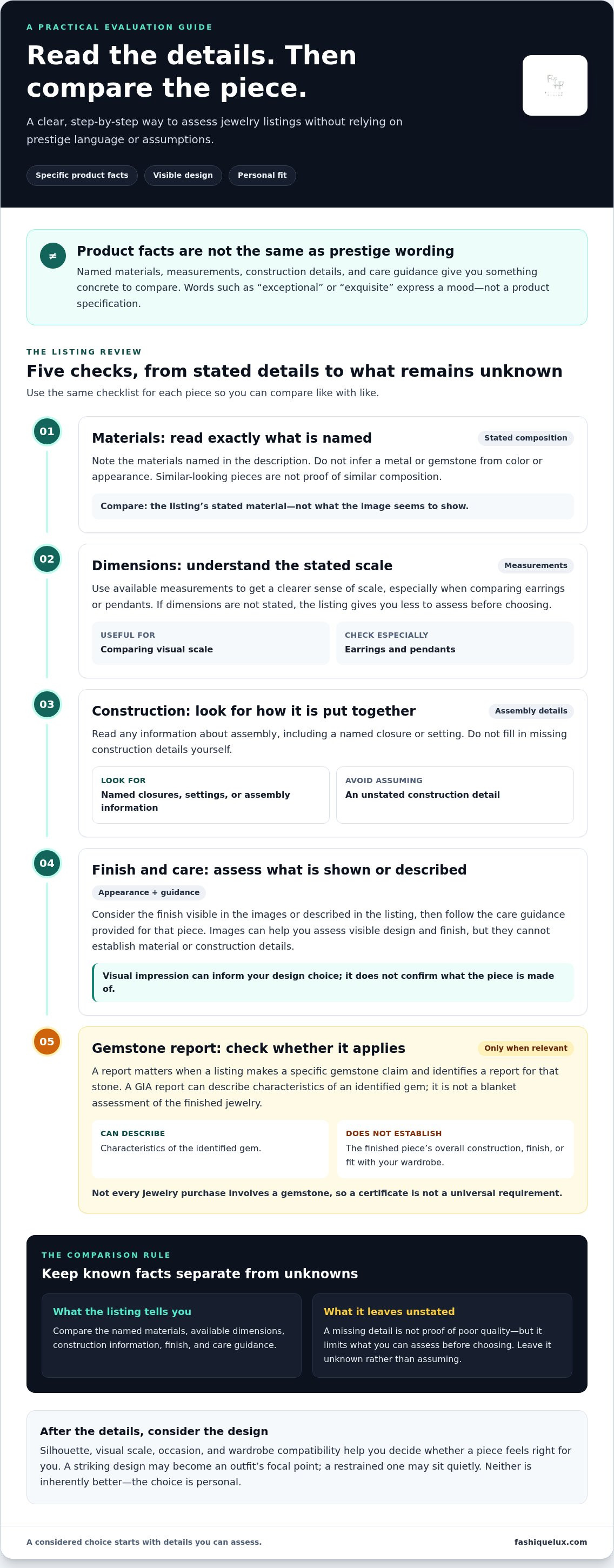
A polished description can create an impression of quality without explaining what a piece is made of or how it is put together. Look for specifics. A named material, dimension, closure, or care instruction gives you something concrete to compare. Words like “exceptional” or “exquisite” express a mood, not a specification.
Clear product information is more useful than prestige wording alone because it lets you judge what the listing actually describes. For high end jewelry, that distinction helps you compare pieces without making assumptions. Similar appearances do not prove similar composition. Likewise, a detail missing from a listing is not proof of poor quality, but it limits what you can assess before choosing.
Which product details should you read before choosing?
Use the same checklist for each piece so you can compare like with like. Look for materials stated by name, available dimensions, the type of closure, and care instructions. Images can help you assess the visible design and finish, but appearance alone cannot establish a material or construction detail. If two earrings look alike, do not assume they share the same composition.
- Materials: Note exactly what the description names. Do not infer a metal or gemstone from color or appearance.
- Dimensions: Use stated measurements to understand scale, especially when comparing earrings or pendants.
- Construction: Read any information about how the piece is assembled, including a named closure or setting, rather than filling in gaps yourself.
- Finish and care: Consider the finish shown or described, then follow the care guidance provided for that piece.
Evocative language can help convey a design’s character, but it is not a substitute for specific product facts. The Gemological Institute of America’s discussion of historical jewelry design and materials offers context on how aesthetics and materials can shape a piece. Keep that broader perspective separate from the facts stated in an individual listing.
When do gemstone reports and certifications matter?
A gemstone report is relevant when a listing makes a specific gemstone claim and identifies a report for that stone. A GIA report can describe characteristics of an identified gem; it is not a blanket assessment of every part of the finished jewelry. It does not, by itself, establish the piece’s overall construction, finish, or suitability for your wardrobe. Not every jewelry purchase involves a gemstone, so a certificate is not a universal requirement.
Compare only details you can see in the descriptions. If a listing names a report, treat it as information about the identified gem, not proof of unrelated qualities. If a material or construction detail is not stated, leave it unknown rather than assuming. Apply the same approach across necklaces, earrings, bracelets, and sets when you explore Fashique Lux’s curated jewelry categories.
How to Compare High-End Jewelry by Design, Occasion, and Versatility
A piece can be beautiful on its own and still feel out of place with a particular outfit or occasion. Compare it in context: its silhouette, visual scale, and the clothes you expect to wear with it all shape the effect. Versatility does not mean choosing the most understated option. It means knowing where and how you would enjoy wearing a piece.
How should jewelry scale relate to an outfit?
Start with the neckline, garment details, and the outfit’s focal point. A necklace may stand out against a simple neckline, while an embellished top may already draw attention. Earrings can bring focus toward the face; a bracelet can add a quieter accent. A coordinated jewelry set creates a unified impression, while one statement piece gives the outfit a distinct focal point. Neither approach is superior.
| Silhouette | Visual scale | Occasion | Wardrobe compatibility |
|---|---|---|---|
| Simple necklace or earrings | Subtle | Everyday plans or daytime gatherings | May suit outfits with varied necklines or details; consider how the piece sits with your usual clothing. |
| More expressive earrings or bracelet | Noticeable | Evening dinners or formal events | Can become the focal point; consider whether the outfit leaves room for its shape and presence. |
| Coordinated jewelry set | Unified, depending on the pieces | Celebrations or bridal styling | Creates a consistent impression; consider whether you’d also wear the pieces separately. |
Florida occasions offer useful styling scenarios without defining anyone’s routine. An outdoor celebration, a formal evening, or a coastal daytime gathering may each call for a different balance of detail and visual presence. Picture the specific event and the clothing you plan to wear rather than expecting one piece to work everywhere.
How do occasion and repeat wear change the comparison?
Daily wear, formal events, and bridal styling have different priorities. For regular use, consider comfort and whether the design works with outfits you wear often. For an evening occasion, decide whether you want a subtle accent or a stronger focal point. For bridal styling, consider how the jewelry relates to the outfit and whether a coordinated set or a single piece better suits the look.
Ask yourself how often you can imagine reaching for the piece, whether its scale feels comfortable, and how easily it works with more than one outfit. These are personal comparisons, not promises about a product’s durability or suitability. A statement earring may feel right for a particular occasion even if it is not your everyday choice. A quieter necklace may suit repeat wear, but that does not make it the better option for everyone.
Use the table as a starting point, then compare your own occasion, preferred focal point, and wardrobe. Explore Fashique Lux’s curated jewelry edits to consider necklaces, earrings, bracelets, jewelry sets, and bridal pieces through that lens.
How to Choose High-End Jewelry That Feels Personal
A clear starting point makes browsing more intentional. Instead of moving through every category at once, choose one priority: an occasion, a piece to wear often, or a design quality you are drawn to. That focus helps you judge each option against your life, not an abstract idea of what high end jewelry should be.
Use this sequence to shape your choice:
- Define the occasion. Decide whether you’re choosing for personal wear, a gift, a formal event, or bridal styling. The purpose gives the piece a role.
- Choose a category. Start with the form that best serves the look, such as earrings for a focal point near the face, a necklace for the neckline, or a bracelet for a more discreet accent.
- Set a design preference. Note whether you’re drawn to a restrained or expressive silhouette, a subtle or noticeable scale, and clean or more detailed forms. You don’t need to decide on a material first.
- Review the details. Read the description and care information, and look closely at available imagery. Keep your assessment grounded in what’s stated or visible.
- Compare a shortlist. Consider each piece against the same occasion, style preference, and information needs. A focused comparison is easier to trust than an open-ended search.
What should you decide before browsing?
Let the occasion narrow the field, then consider how distinctive you want the piece to feel. For a gift, think about the recipient’s usual style rather than choosing by prestige alone. For an event, decide whether jewelry should lead the look or complement it. A preferred scale and design character give you direction without assuming a specific material.
Personal style also includes comfort and compatibility. Consider whether a piece’s visual presence feels like you and how it might sit alongside jewelry you already wear. An expressive design can still feel natural if it suits your preferences; a subtle one is not automatically more versatile. Picture the piece with a few outfits you genuinely reach for, not a hypothetical wardrobe.
How can you make an online jewelry shortlist?
Compare each candidate using the same questions. Does it suit the occasion? Does the silhouette match your preference? Do the description and imagery give you the information you need to decide? If dimensions or care guidance are provided, consider them in context. Do not fill in details the listing does not state or assume every piece comes with the same information or policies.
Keep only the pieces that meet your essential criteria. Then distinguish attraction from fit: one design may be striking at first glance, while another may better suit your existing pieces and preferred level of comfort. Neither response is wrong. The useful choice is the one you can explain in personal terms.
A confident choice connects personal style with clear product information. With your criteria in hand, browse Fashique Lux’s curated jewelry selection and consider each piece through the lens of the occasion, category, and design character you’ve chosen.
Explore Fashique Lux’s Curated High-End Jewelry Edit
Fashique Lux is an online retailer of curated luxury accessories and fine jewelry. Its jewelry edit includes necklaces, jewelry sets, bracelets, earrings, and bridal pieces. Start with the occasion, look, or type of piece you have in mind, then assess each individual description on its own terms. A category is a useful starting point, not a guarantee about a particular piece’s materials or details.
Which jewelry category fits the look you have in mind?
Choose the form that best serves the outfit and the effect you want. A necklace can draw attention to a neckline or act as a considered accent. Earrings bring a focal point closer to the face, while a bracelet offers a different kind of detail. Jewelry sets create a coordinated direction, and bridal pieces offer a dedicated category for readers refining a wedding-day look.
These choices are not interchangeable. If your outfit already has a prominent neckline, you might begin with earrings or a bracelet. If you want the jewelry to frame a neckline, start with necklaces. For a unified impression, compare a set with the option of choosing a single category. Your occasion and preferred visual scale can help you decide where to begin.
A simple way to focus your search is to keep one question in view:
- Necklaces: What neckline or outfit detail should the piece complement?
- Earrings: Do you want a subtle accent or a more noticeable focal point?
- Bracelets: Would this detail fit the way you like to finish an outfit?
- Jewelry sets: Does a coordinated look suit the occasion?
- Bridal pieces: How should the jewelry relate to your wedding-day styling?
How can a curated edit make browsing more intentional?
Browsing by category turns a broad choice into a more manageable one. Begin with the form that fits your purpose, then compare individual listings using the same criteria: silhouette, visual scale, occasion, and compatibility with pieces you already wear. Read each description carefully, and base your understanding on what it states rather than assuming details from appearance or category alone.
This approach keeps the edit personal. A piece may suit a formal event but not your everyday preferences, or feel right for repeat wear because its design works with outfits you already enjoy. Neither result needs to be universal. The useful question is whether this particular piece answers your original brief.
With your priorities in mind, Discover the Fashique Lux jewelry edit. Let the occasion, design, and stated details guide your choice.
Let Your Next Choice Reflect Your Point of View
The right piece does not need to define your entire style. It can mark a moment, bring focus to an outfit, or simply feel at home among the things you already wear. High end jewelry feels most personal when it reflects what you are drawn to, rather than what a label suggests you should value.
Give yourself room to notice what holds your attention: a silhouette, a particular sense of scale, or a category that suits the occasion ahead. Fashique Lux offers curated luxury accessories and fine jewelry online, including necklaces, jewelry sets, bracelets, earrings, and bridal pieces. Browse with your priorities in mind, and let a piece earn its place through its appeal to you.
Explore the Fashique Lux jewelry edit to find a piece that feels considered, personal, and distinctly yours.
Frequently Asked Questions
What is considered high-end jewelry?
High-end jewelry is a broad description, not a universal grade with one fixed price or material requirement. A considered choice has qualities you can assess in context, such as its design, stated composition, and the information supplied with the piece. The phrase alone does not establish those details. Look more closely, then decide whether the piece suits your preferences and intended use.
How can you tell if jewelry is high quality?
Look for product information that helps you understand what you are considering, then examine available images for visible finish and consistency. If a listing identifies a clasp or construction detail, use that information when comparing similar pieces. Images and descriptive language cannot establish every underlying fact, so do not treat appearance as proof of an unstated specification. Assess the evidence the listing actually provides.
Is high-end jewelry always made with precious metals or gemstones?
No. The phrase does not automatically mean a piece contains a precious metal or gemstone. Jewelry can be valued for its form, finish, or personal significance, but those qualities do not identify its composition. If a particular metal or stone matters to your decision, look for it to be explicitly named in the product information. Do not infer it from color, styling, or a luxury description alone.
Are high jewelry and fine jewelry the same thing?
No single definition makes these terms interchangeable across retailers. “High jewelry” is often used for exceptional, elaborate designs, while “fine jewelry” may be used differently by another seller. Neither phrase, on its own, tells you every material or construction detail. Read the description as a whole and use specific product information to understand what the terminology means for the individual piece.
Can high-end jewelry be worn every day?
Some pieces may suit frequent wear, but the label alone cannot establish comfort or everyday suitability. Consider the design’s scale, how it feels for the activities you have in mind, and any care instructions provided. Florida residents may also consider the settings in which they plan to wear a piece, from workdays to evening plans. Follow the care guidance for that piece rather than assuming all jewelry has the same needs.
How do you choose high-end jewelry as a gift?
Start with the recipient’s established taste and the occasion. Notice whether they usually choose understated or expressive accessories, and whether they often wear earrings, necklaces, or bracelets. In Florida, a gift for a formal celebration may call for a different look than one intended for regular use. Choose a category that fits their habits, then review the item’s stated details so the gesture feels personal, not generic.
Does high-end jewelry need a gemstone certificate?
No. A certificate is not a universal requirement for every jewelry purchase, particularly when the piece does not make a gemstone claim. If a listing identifies a gemstone report, read what it covers: a report concerns characteristics of the identified gem, not every feature of the finished piece. Use it as one source of information alongside the item description, not as a complete assessment of the jewelry.


Leave a comment