
What Is a Statement Piece in Jewelry? A Modern Guide
What if the piece that changes an outfit isn’t the biggest one? Asking what is a statement piece in jewelry can feel like a question of taste, especially when the phrase suggests something oversized, bright, or reserved for a special occasion. But presence isn’t measured in scale or price. It comes from the way a piece draws the eye and gives a look its focus.
That distinction makes expressive jewelry easier to wear. A considered detail can feel more compelling than a dramatic silhouette, particularly when it reflects your own style. The key is intention, not excess.
This guide explains what gives jewelry its statement-making quality, how that presence can appear across necklaces, earrings, bracelets, and sets, and how to style a focal piece with balance. You’ll learn to spot impact in different forms, choose jewelry that feels distinctly yours, and wear it with confidence, from everyday plans to more considered occasions in Florida and beyond.
Key Takeaways
- Understand what is a statement piece in jewelry by looking for distinctive visual presence, not a specific size or price.
- Learn to spot the design cues that create impact, from silhouette and proportion to color, texture, detail, and contrast.
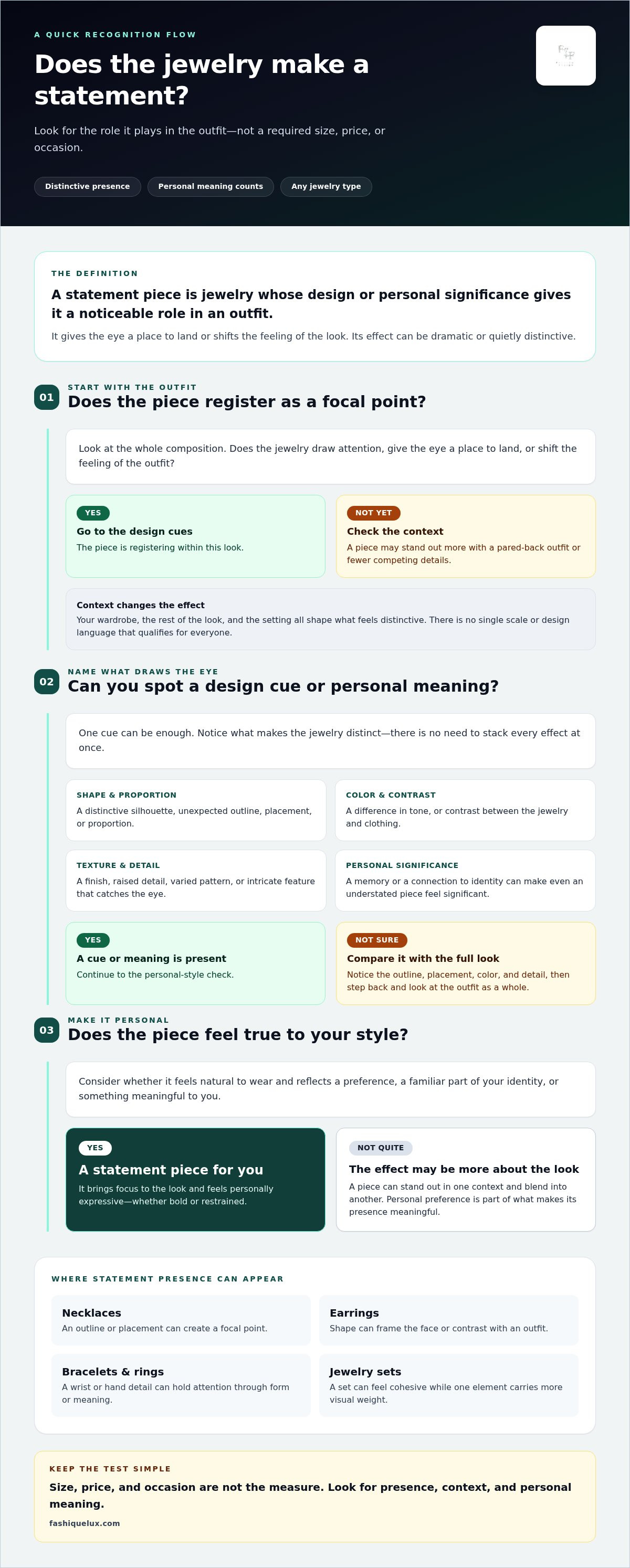
- Use a simple recognition process: find the focal point, identify what draws the eye, then consider whether it feels true to your style.
- Explore how statement-making presence can appear in necklaces, earrings, bracelets, and jewelry sets.
What Is a Statement Piece in Jewelry? A Clear Definition
A statement piece is defined by the visual presence it brings to a look. It becomes a focal point through a distinctive silhouette, considered contrast, striking detail, or personal meaning. It doesn’t need to be oversized or costly. It needs to register.
A statement piece in jewelry is an item whose design or personal significance gives it a noticeable role in an outfit, regardless of its size or price.
That presence can come from shape, such as an unexpected outline that feels sculptural against simple clothing. It can come from color, texture, intricate detail, or contrast between the jewelry and the rest of the look. Even a restrained design may feel distinctive when it stands apart from what you usually wear. The effect depends on what the jewelry draws attention to, not on how many bold features it has.
The Statement necklace is a familiar expression of the idea, but necklaces are only one example. To answer what is a statement piece in jewelry, look at the role a piece plays. Does it give the eye a place to land? Does it shift the feeling of the outfit? If so, it may be making a statement, whether its effect is dramatic or quietly distinctive.
Why the Meaning of Statement Jewelry Is Personal
Visual impact isn’t universal. One person may be drawn to an architectural outline; another may notice a subtle piece because it carries a memory or reflects a familiar part of their identity. Personal meaning can make jewelry feel significant even when its design is understated.
Context matters, too. A piece that feels expressive with a pared-back outfit may blend into a more elaborate look. Your preferences, wardrobe, and the setting all shape what feels distinctive. There’s no single scale, trend, or design language that qualifies for everyone.
Statement Jewelry Is Not One Specific Jewelry Type
Statement presence can appear in necklaces, earrings, bracelets, rings, or coordinated sets. A necklace might draw focus through its outline, while earrings can frame the face. A bracelet may become the most noticeable detail at the wrist; a ring can hold attention through its form or meaning. These are examples across jewelry categories, not fixed rules about how a piece must look.
The category doesn’t define the statement. The expression does. Choose the form that feels natural to wear, then notice what makes it stand out in your wardrobe. Necklaces, earrings, bracelets, and jewelry sets offer different ways to explore that presence without limiting it to a single type of jewelry.
The Design Cues That Give Jewelry Its Statement-Making Presence
Visual presence comes from design choices, not a checklist of bold features. Silhouette, proportion, color, texture, detail, and contrast are cues that can give jewelry a statement-making presence. One may be enough. A distinctive outline can hold the eye on its own, while several restrained details can work together to create a quieter effect.
To understand what is a statement piece in jewelry, consider how it reads within an outfit. A necklace may create a focal point through its shape or placement. Earrings can frame the face with an unexpected outline; a bracelet can stand out against a simple sleeve. Context helps the design register. Jewelers Mutual’s guide to What is Statement Jewelry? also explores how statement jewelry can express individuality across different types of jewelry.
Scale and Silhouette Without the Size Rule
Scale is relative. A piece’s outline, placement, and proportion determine how it relates to the body and clothing around it. A smaller design with a crisp, unusual shape may draw the eye more readily than a larger piece with a familiar profile. Concentrated detail can also make a modest area feel visually important.
Consider the whole composition. A necklace against a clean neckline may be more prominent than the same piece layered among competing details. Earrings can become a focal point when their shape contrasts with the lines of an outfit. There is no universal measurement that makes jewelry a statement. The effect depends on what the eye notices first.
Color, Texture, and Contrast as Visual Signals
Color creates presence through its relationship with clothing. A clear difference in tone can make jewelry stand out; a close tonal pairing can feel more subtle, yet still draw attention through shape or finish. Texture adds another layer. Smooth surfaces, raised details, or varied patterns can catch the eye differently, even within a restrained palette.
Contrast can come from more than color. A precise, geometric outline against soft clothing, or a finely detailed piece against a plain neckline, gives the eye a point of distinction. A coordinated jewelry set may feel cohesive while one element carries more visual weight. A single earring or bracelet can also provide the only contrast in an otherwise quiet look. Choose the cue that feels most natural to your style, rather than stacking every effect at once.
For a practical test, view the piece with the outfit you intend to wear. Notice its outline, where it sits, and whether color or detail stands apart. Then step back and look at the whole outfit. If the jewelry gives the look a clear focal point without competing with every other detail, its presence is doing enough. A curated selection of jewelry in distinct categories offers different ways to explore that balance.
Statement Jewelry Myths: Size, Price, and Occasion Are Not the Test
Statement jewelry is often imagined as oversized, costly, or reserved for a formal entrance. Those associations can make expressive pieces seem harder to wear than they are. A better measure is the role a piece plays in your look: whether it feels distinctive and gives the outfit a point of focus. The question, what is a statement piece in jewelry, has no answer based on size, price, or a particular event.
Myth: Statement jewelry has to be loud. Reality: A design can feel expressive through its outline, detail, or contrast without dominating the wearer.
Myth: Only expensive or fine jewelry can make a statement. Reality: Fine jewelry and fashion jewelry can both have visual impact. Appearance alone doesn’t establish a piece’s materials, quality, or value.
Myth: Statement pieces belong only at special events. Reality: A focal piece can also suit everyday dressing when it feels comfortable and right for the context.
Does Statement Jewelry Have to Be Large or Expensive?
No. Neither size nor price alone determines statement presence. A necklace with a distinctive outline may draw the eye without being oversized; earrings or a bracelet can become a focal point through their design or placement. A smaller piece may also stand out against a simple outfit. These examples describe visual effect, not the materials or value of any particular piece.
Fine jewelry and fashion jewelry are different classifications, but neither automatically guarantees a statement effect. A high price doesn’t make a piece visually distinctive, just as a more accessible price doesn’t prevent it from expressing personal style. Look at what the design contributes to the outfit, rather than assuming cost or scale will do the work.
Is Statement Jewelry Only for Special Occasions?
No. Occasion is part of the context, not a rule that limits when a piece can be worn. A necklace, earrings, or bracelet that feels striking with an evening look may also bring focus to everyday clothing. The same piece can read differently across settings, depending on the rest of the outfit and how you feel wearing it.
Comfort matters. If a piece feels natural for your plans and personal style, it doesn’t need a formal event to justify wearing it. For a quieter approach, let one accessory take the lead and keep other details restrained. If you enjoy a more expressive look, choose combinations that feel cohesive to you. There isn’t one correct balance for every wearer or occasion.
The useful distinction is between impact and excess. Statement jewelry is expressive, but expression doesn’t require maximum scale, a high price, or a special invitation. A considered choice can feel entirely at home in an ordinary day. Let the piece suit your taste and the moment, rather than dressing to meet someone else’s definition of “statement.”
How to Recognize a Statement Piece That Feels Like You
A piece can be visually distinctive and still not feel like yours. The difference often lies in whether its presence connects with your taste, wardrobe, and comfort. If you’re asking what is a statement piece in jewelry, move beyond trend labels. Look closely, name what draws your eye, then decide whether that feature expresses something you want to wear.
A Three-Step Test for Visual Presence
Use this quick test when considering a piece, whether it’s a necklace, earring, bracelet, ring, or coordinated set.
- Notice the focal point. Look at the piece as a whole, then ask what catches your attention first. It might be one part of the design, its placement, or the way its overall form reads.
- Name the design cue. Is it the silhouette, color, texture, contrast, or a particular detail? Being specific helps distinguish a thoughtful focal point from something that simply feels unfamiliar.
- Check for personal resonance. Does that feature feel expressive to you, or is it only noticeable? A strong choice may reflect your preferences, suit your natural way of dressing, or carry a meaning you value.
There’s no correct answer to the final question. The point is to understand why the piece stands out to you, rather than relying on someone else’s definition of bold.
Personal Style and Everyday Context
Your wardrobe provides useful context. Consider the clothes you actually reach for, not only the look you admire in a photograph. A piece may feel at home with the silhouettes and colors you wear often, or it may offer a deliberate contrast that still feels like you. Either can work. The test is whether you can imagine choosing it again, not whether it follows a trend.
Think about the setting, too. The same jewelry can read differently with relaxed daytime clothing or a more considered outfit. Comfort matters alongside appearance: notice whether the piece feels natural for your plans and the way you move through the day. If you find yourself adjusting your choice to match an imagined dress code, pause and consider what feels right to you instead.
Boldness is personal. For one wearer, a restrained detail may feel unusually expressive; another may prefer a more pronounced focal point. Neither approach is more correct. A useful decision comes from the meeting of visual interest and personal ease, not from matching a prescribed level of drama.
For a necklace-specific perspective, a designer necklace guide can offer a narrower lens on form and personal preference. To explore different expressions of style across jewelry categories, browse curated jewelry styles and notice which details feel most distinctly your own.
Statement Jewelry Across Fashique Lux’s Curated Categories
Statement presence isn’t confined to one form. Across necklaces, earrings, bracelets, and jewelry sets, a distinctive design can offer a different expression of personal style. The category is a starting point, not a rulebook. What matters is how a piece draws the eye and whether its character feels like your own.
From Necklaces to Earrings, Bracelets, and Jewelry Sets
A necklace may create a focal point through its overall shape or the way it sits within an outfit. Earrings bring attention to the face, while a bracelet can lend a considered accent at the wrist. In a jewelry set, the pieces can feel connected, with one element becoming the strongest visual note. These are possibilities, not fixed formulas. The same category can feel subtle or expressive depending on its design and the wearer’s choices.
That variety is useful when exploring what is a statement piece in jewelry beyond the familiar necklace. Perhaps you’re drawn to a clear, defined outline; perhaps a small detail feels more compelling. An earring, bracelet, or coordinated set can carry that quality just as naturally. The visual role, rather than the category, gives the piece its presence.
A Considered Way to Explore Expressive Jewelry
Let the cues you’ve noticed guide your attention. If contrast appeals to you, look for pieces whose design feels distinct against your wardrobe. If shape matters more, focus on how the outline speaks to your personal taste. A considered edit makes it easier to compare different expressions without assuming that one level of boldness is right for everyone.
Fashique Lux brings together curated jewelry across necklaces, earrings, bracelets, and jewelry sets. Exploring those categories can help you refine what feels distinctive to you: a design that adds focus, a form that feels familiar, or an unexpected detail that shifts the mood. You don’t need to choose by trend or make every accessory compete for attention. Begin with the quality you’re drawn to, then consider which category feels most natural in your wardrobe.
The most compelling choice is one you can imagine wearing with ease. A statement doesn’t have to announce itself loudly to feel intentional. It can be the detail that makes an outfit feel more personal, or the piece that holds your attention for reasons only you can name. Explore Fashique Lux’s online jewelry selection and follow the designs that feel distinctly yours.
Choose the Detail That Feels Like You
The most memorable choice isn’t always the most dramatic. Let curiosity lead. Notice the piece you return to, the detail that feels considered, and the expression that feels natural rather than borrowed. That instinct is a more lasting guide than any trend rule.
If you’re still asking what is a statement piece in jewelry, trust the piece that brings a distinct point of view to your look and feels at ease in your life. Fashique Lux curates luxury accessories and fine jewelry, with necklaces, earrings, bracelets, and jewelry sets offering different ways to explore personal style.
Explore Fashique Lux’s curated jewelry selection and find a piece that speaks to your own sense of expression. Wear it your way.
Frequently Asked Questions
Can a small piece of jewelry be a statement piece?
Yes. A small piece can hold attention through a precise detail, an unusual shape, or a personal association. To decide, look at it alongside the outfit you plan to wear rather than judging it alone. A compact pair of earrings, for example, may feel especially expressive with a simple hairstyle or a clean neckline. The answer to “what is a statement piece in jewelry” depends on its effect, not its dimensions.
Are statement pieces only necklaces?
No. Earrings, bracelets, rings, and coordinated jewelry sets can all create a focal point. Consider where you want the eye to land: earrings can draw attention upward, while a bracelet may add interest to a look with visible sleeves. A necklace is simply one familiar option. Choosing a category that feels comfortable for your routine can make expressive jewelry easier to reach for and wear with confidence.
Does statement jewelry have to be expensive?
No. Price doesn’t determine whether jewelry makes a statement. The visual role and personal significance of a piece matter more than its cost. If you’re comparing options, focus first on what you respond to: the outline, a detail, or how it complements a favorite outfit. Don’t assume a striking appearance reveals a piece’s materials or value. Those are separate considerations from its expressive effect.
Can statement jewelry be worn every day?
Yes, if it suits your plans and feels comfortable in your routine. A piece you enjoy with everyday clothing doesn’t need to be saved for an event. In Florida, you might choose differently for a casual daytime outing than for an evening gathering, while keeping your own preferences in view. Consider how the jewelry feels as you move through the day, not only how it looks when first put on.
How do you balance a statement piece with other jewelry?
Try the focal piece with your usual accessories, then remove one item at a time and see whether the overall look feels more deliberate. This simple edit helps reveal which pieces complement each other and which compete for attention. You can also repeat a visual quality, such as a similar shape or tone, to create cohesion. There’s no requirement to leave other jewelry off if the combination feels balanced to you.
Is statement jewelry the same as costume jewelry?
No. “Statement” describes the role jewelry plays in a look; “costume” or “fashion” jewelry describes a category of jewelry. Fine jewelry can be a statement, and fashion jewelry can be as well. The terms answer different questions. One describes visual impact; the other relates to how a piece is classified. Avoid judging the category or quality from appearance alone, since a bold look doesn’t establish what a piece is made from.


Leave a comment